
Why Your Business Isn’t Showing Up in ChatGPT or AI Search
Search behaviour is changing from “give me links” to “give me an answer.” For service-based businesses, that shift matters because prospects increasingly ask ChatGPT and other AI-powered search experiences questions that previously went directly to Google: Which agency should I hire? Which company provides this service in my city? What should this service cost? Which provider has relevant industry experience?
OpenAI confirms that ChatGPT Search evaluates information using factors including user intent, relevance and recency, while responses can include direct citations to web sources. That creates another discovery environment alongside traditional SEO, SEM, PPC, social media marketing and referral channels.
AI search visibility is a business’s ability to be discovered, understood, referenced or cited when generative search systems answer commercially relevant questions.
Strong AI visibility depends on accessible web content, clear entity information, topical authority, technically sound websites and credible third-party signals, not simply inserting AI-related keywords into pages.
Why a Good-Looking Website Can Still Be Invisible
A polished UI/UX design does not automatically explain what an organisation does, where it operates, whom it serves or why it deserves consideration.
AI systems need machine-accessible evidence.
OpenAI specifically advises publishers wanting inclusion in ChatGPT Search to allow OAI-SearchBot access; inclusion or placement is not guaranteed. A technically blocked website therefore creates an obvious discoverability problem.
The same principle applies to Google Search Central. Search visibility requires crawlable pages, sensible site architecture, descriptive titles, internal linking and useful content. Google also recommends structured data as explicit information that helps its systems understand page meaning.
For a corporate service provider, that might mean Organization, Service, Breadcrumb and relevant LocalBusiness information implemented accurately rather than dumping unnecessary schema markup across WordPress or another CMS.
Technical performance matters too. Google’s Core Web Vitals measure loading performance, responsiveness and visual stability through LCP, INP and CLS. Web development, SEO and conversion rate optimization (CRO) therefore cannot operate as isolated disciplines.
AI Search Rewards Clarity Around Expertise
Consider two B2B consultancies.
Company A has a beautiful homepage saying, “Transforming tomorrow through innovation.”
Company B has dedicated pages explaining its services, sectors, methodologies, locations, project outcomes, FAQs and technical expertise.
Company B provides considerably more evidence for search engines and generative systems to interpret.
That becomes especially important for service companies competing across Lahore, Karachi or Islamabad, or internationally in markets such as Dubai and London. A generic “global solutions” page provides weaker contextual information than substantive pages explaining actual capabilities, industries and geographic service coverage.
Content marketing therefore becomes infrastructure for discovery. Useful comparisons, technical guides, case studies, pricing explanations, implementation frameworks and buyer FAQs create retrievable information around the questions prospects actually ask.
What This Looks Like in Practice
In a composite B2B industrial-services project representative of WebInfinites’ work, the starting problem was not simply low traffic. The website relied heavily on branded discovery and lacked sufficient non-branded content around the services buyers researched.
The scope combined technical SEO, keyword-to-page mapping, site architecture improvements, content development, AEO/GEO formatting and stronger service-page relevance. Over a three-month measurement period, organic visibility exceeded 147,000 impressions and generated more than 5,000 clicks, while approximately 12,000 website visits demonstrated how systematic discoverability can expand an established corporate brand beyond branded searches.
The lesson is important: AI visibility should complement proven acquisition infrastructure rather than replace it.
Evaluate the Entire Discovery System
AI visibility should not be purchased as an isolated “GEO package.” Effective implementation begins with the digital infrastructure supporting the brand.
An agency should assess technical SEO, crawlability, site architecture, Core Web Vitals, internal linking, schema markup, content quality, entity consistency, backlink authority, local SEO, and conversion pathways. It should also determine whether relevant AI crawlers can access important content.
Web development and UI/UX design become part of the same commercial system. Ranking or receiving an AI citation has limited value if visitors reach a slow website, cannot understand the service proposition, or struggle to request a quotation.
For businesses using WordPress, technical work may include template optimisation, image compression, caching, plugin rationalisation, canonical management, and structured data. Shopify e-commerce businesses require different considerations around product architecture, collections, duplicate URLs, structured product information, and CRO.
Measure Revenue, Not AI Mentions
The meaningful journey is:
buyer question → discovery → website visit → evaluation → enquiry → qualified opportunity → revenue.
That journey should shape measurement.
Google Analytics 4 can track important interactions such as quotation requests, contact forms, purchases, telephone clicks, and demonstration bookings. OpenAI also adds utm_source=chatgpt.com to ChatGPT referral URLs, allowing businesses to identify inbound ChatGPT traffic within analytics platforms.
However, traffic alone is insufficient.
Suppose improved SEO, AEO, and generative engine optimization produce 15 additional qualified enquiries per month. If five become sales opportunities and two convert into £8,000 projects, the commercial discussion changes from “How many AI citations did we receive?” to “How much pipeline did increased discoverability influence?”
Attribution should still account for margins, sales cycles, repeat business, and multi-touch journeys involving PPC, content marketing, email, social media marketing, or direct searches.
Where WebInfinites Fits
WebInfinites approaches AI visibility as an extension of corporate digital strategy rather than a replacement for SEO.
This is particularly relevant for technically complex and corporate industries, where an agency must understand more than advertising. A B2B service page may need to communicate technical capability, sector experience, geographical coverage, project evidence, and buyer-specific value while remaining understandable to search engines and generative systems.
WebInfinites combines SEO, AEO, GEO, content strategy, branding, web development, UI/UX design, and conversion thinking around that requirement. Its corporate-industry focus also differentiates the approach from agencies primarily structured around consumer social media campaigns.
For companies operating from Pakistan while pursuing opportunities in the UAE, Saudi Arabia, UK, or USA, this becomes especially important. International visibility requires market-specific search intent and credible service relevance rather than simply inserting Dubai, London, or other locations into generic pages.
What Should You Ask an Agency?
Before appointing a digital marketing or AI-search agency, evaluate whether it can:
- perform technical SEO and AI-crawler accessibility audits;
- map services against commercial search intent and real buyer questions;
- implement appropriate schema markup rather than merely recommend it;
- demonstrate experience with GA4 attribution and conversion tracking;
- connect SEO, AEO, GEO, branding, content, and web development;
- improve website UX and conversion rate optimization alongside visibility;
- distinguish organic AI discovery from SEM, PPC, and paid media;
- show measurable outcomes from previous projects; and
- explain limitations instead of guaranteeing ChatGPT rankings.
Guaranteed AI rankings should be treated cautiously. Generative systems determine which sources are useful for individual questions, and visibility can change according to relevance, authority, freshness, context, and retrieval systems.
The Competitive Advantage Is Earlier Discovery
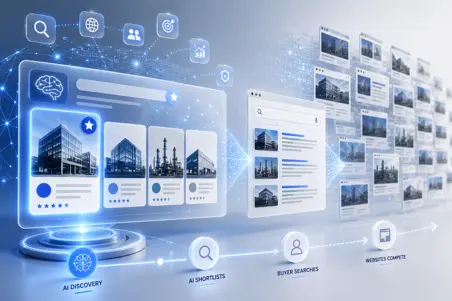
AI search, voice search, generative recommendations, and increasingly automated research are shortening the traditional marketing funnel. Buyers can investigate requirements, compare approaches, identify providers, and develop shortlists before contacting a company.
That changes what digital visibility means.
The strongest strategy is not choosing between SEO and AI search. It is creating a digital presence that can be crawled, understood, trusted, retrieved, and converted across multiple discovery environments.
For service-based businesses, the objective should therefore be broader than “getting into ChatGPT.” The objective is becoming sufficiently clear, authoritative, technically accessible, and commercially relevant that the business can appear wherever qualified buyers conduct research.
That is the direction WebInfinites builds toward: visibility that supports consideration, consideration that generates qualified opportunities, and digital investment that can ultimately be connected to revenue.
Questions Service Businesses Are Asking
Why doesn’t ChatGPT mention my company?
Is traditional SEO still necessary?
Does schema markup guarantee AI citations?
Do service businesses need local SEO for AI search?
Can PPC or social media marketing improve AI visibility?
Want to know what’s holding your site back?
Explore our approach to B2B Engineering Website Design or get in touch for a strategic website review.
