
Why Enterprise Discovery Is Moving Upstream Into AI Search
Enterprise buying journeys are changing. A buyer no longer has to begin with a short Google query and open ten websites. The first research step can instead be a detailed AI-search question: which vendors fit a requirement, how competing approaches differ, what implementation risks matter, and what criteria should shape a shortlist.
AI search as a first touchpoint is the use of generative or answer-driven search experiences at the beginning of a buyer’s discovery and evaluation journey, before direct engagement with a vendor.
It compresses research, comparison, and source discovery into one interface.
This matters because Google says users are gravitating toward generative AI experiences, while AI Mode is designed for nuanced questions, complex comparisons, and exploration that previously required multiple searches. Google also confirms that AI Overviews and AI Mode can use query fan-out to retrieve information across related subtopics and sources.
The First Impression Can Happen Before the Website Visit
SEO remains fundamental, but visibility extends beyond ranking one keyword. An enterprise buyer researching “industrial digital marketing agencies with B2B SEO experience in the UAE” may encounter summarized capabilities, supporting sources, comparisons, and follow-up answers before visiting an agency website.
That changes content marketing, branding, web development, and technical SEO. Clear architecture, crawlable expert content, internal linking, accurate schema markup, and evidence help search systems understand a company. Google states that pages must remain indexable and eligible for Search to appear as supporting links in generative features.
For companies in London, Dubai, or Lahore, the objective is not “AI instead of Google.” It is discoverability across SEO, AEO, and generative engine optimization while preserving a persuasive human journey.
AI Visibility Still Depends on the Website Beneath It
A technically weak website cannot be rescued by fashionable GEO tactics. Core Web Vitals, page speed, site architecture, canonicalization, indexation, and accessible text remain foundations. Google advises businesses to prioritize established SEO practices rather than supposed AEO/GEO hacks.
WordPress and Shopify implementation choices still matter, while GA4 and Google Search Console should connect discovery with measurable behaviour. Google began rolling out dedicated generative-AI visibility reporting in Search Console in 2026.
A WebInfinites industrial B2B project illustrates the broader principle. Across a three-month SEO-led engagement covering technical improvements, content architecture, regional search intent, and authority-focused publishing, website visitors rose from roughly 1,400 in an earlier three-month period to more than 12,000 in a later three-month period, with 147,000 search impressions and 5,000-plus clicks. The result should not be attributed solely to AI search; it shows why a technically accessible, evidence-rich content base is necessary before AEO or GEO visibility can become commercially meaningful.
Evaluate the Foundation Before the AI Layer
Start with the audit. A partner should inspect crawlability, indexation, architecture, Core Web Vitals, internal linking, structured data, conversion paths, and analytics before prescribing content. On WordPress, Shopify, or another CMS, the agency should understand platform constraints before recommending a rebuild.
Research should move beyond search volume into buyer problems, commercial intent, competitor coverage, entity relationships, and AI-assisted follow-up questions. A property company in Dubai, SaaS provider targeting the USA, and B2B manufacturer selling from Pakistan into Saudi Arabia require different journeys.
Google reinforces this approach: generative Search still depends on crawlable, indexable, useful content, and structured data should correspond with what users can actually see.
How Visibility Becomes Revenue
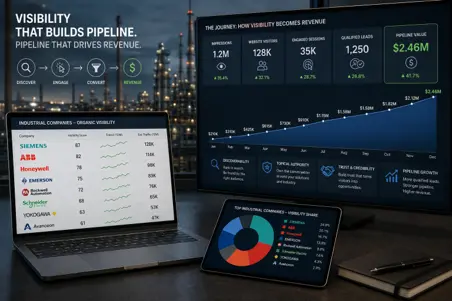
AEO and GEO become valuable when visibility influences discovery, qualified traffic, leads, opportunities, and revenue.
Measurement should connect Search Console, GA4, CRM outcomes, lead tracking, and campaign data. Google defines attribution as assigning credit across ads, clicks, and other factors in the path to a meaningful action; that matters when early research precedes a later return through branded search, PPC, direct traffic, or another channel.
For e-commerce, connect Shopify discovery to checkout behaviour, CRO, and paid media. For B2B, measure qualified enquiries, pipeline value, and cost per opportunity. Traffic is not ROI.
Look for Integrated Capability, Not Disconnected Services
AI discovery exposes the whole digital system. Useful content may earn visibility, but poor UI/UX loses buyers; strong branding creates recall, but weak technical SEO restricts discovery; PPC traffic still fails on inefficient landing pages.
WebInfinites therefore treats SEO, AEO, GEO, content marketing, web development, UI/UX design, branding, analytics, and CRO as connected parts of the funnel. Businesses in Lahore, Karachi, or Islamabad selling into Dubai, London, Saudi Arabia, or the USA need genuine regional evidence—not duplicated city pages built merely for local SEO.
Red Flags When Comparing Agencies
Avoid agencies guaranteeing AI citations, selling proprietary “AI ranking scores” as platform metrics, producing near-identical pages, or treating llms.txt as a shortcut. Google warns against scaled low-value content and says no special AI text file or schema is required for its AI Search features.
Content production must also connect with implementation: a calendar cannot fix blocked crawling, slow templates, broken canonicals, inaccurate schema, or missing conversion tracking.
A Practical Agency Evaluation Checklist
Before appointing a digital partner, assess whether the team can demonstrate:
- Technical SEO auditing and implementation, not merely keyword reports.
- Buyer-intent research covering conventional search and conversational questions.
- Original, expert-led content with credible evidence and entity relationships.
- AEO/GEO practices grounded in search fundamentals rather than guaranteed AI placement.
- Web development and UI/UX capability across relevant CMS platforms.
- GA4, Search Console, conversion tracking, and attribution competence.
- CRO thinking that connects traffic to enquiries, purchases, or pipeline.
- Integrated SEM, PPC, social media marketing, and organic strategy where commercially justified.
- Regional understanding without artificial location-page expansion.
- Reporting that distinguishes visibility metrics from business outcomes.
Preparing for the Next Search Interface
Voice search, multimodal discovery, AI agents, and marketing automation will keep changing research. Google already publishes guidance for agentic experiences that may inspect websites and perform tasks for users.
The durable investment is therefore not a temporary AI-search trick. It is a technically sound website, distinctive expertise, structured information, measurable acquisition, and a brand that remains credible when machines summarize it and humans investigate it.
For WebInfinites, that is the strategic opportunity: help companies build digital infrastructure that can be discovered through Google, interpreted by AI-powered search, validated by decision-makers, and measured through the commercial journey. Enterprise discovery may increasingly begin with an AI answer, but winning the buyer still depends on what the business can substantiate after that first touchpoint.
Questions Enterprise Buyers Are Already Asking
Does AI search replace SEO?
What content is most useful for AI discovery?
Should companies create separate AEO and GEO strategies?
Will PPC and social media marketing still matter?
What Decision-Makers Should Demand From an AI-Search Agency
A practical next step
Before requesting proposals, create a baseline covering organic visibility, paid acquisition, website conversion, Core Web Vitals, branded versus non-branded traffic, lead quality, revenue attribution, and content performance. Give shortlisted agencies the same business objectives and ask each to prioritize the first 90 days.
The strongest proposal should explain priorities, dependencies, reporting cadence, and how strategic decisions will change when performance data challenges the original assumptions.
WebInfinites can be evaluated on that basis: strategy, technical execution, web development, SEO, content marketing,paid media, analytics, and CRO should connect to defined commercial outcomes. The right partnership should make industry leadership visible, measurable, and easier for buyers, and increasingly AI systems to recognize.
Want to know what’s holding your site back?
Explore our approach to B2B Engineering Website Design or get in touch for a strategic website review.
