
Calculating Marketing ROI:
1 Formula and a Reporting Tip at a Time
Did you know that only 39% of marketers feel confident about tracking the ROI of their campaigns?
This figure has been widely cited across multiple industry studies, including reports analyzed by HubSpot on marketing measurement maturity
Despite rising investments in AI automation, digital transformation, and advanced analytics, ROI tracking remains inconsistent across industries — especially in B2B, engineering, manufacturing, and enterprise services.
As Jonathan Aufray, Co-Founder of Growth Hackers, states in his analysis on performance marketing accountability:
“You need to know how much you spend in marketing and how many sales you make thanks to these campaigns. Otherwise, optimization is guesswork.”
At WebInfinites, we see this gap repeatedly. That is why this blog is the first in a 7-part Marketing ROI series, where each formula is unpacked in a standalone blog, with internal linking across the series for long-term SEO and topical authority.
The 7 Core Marketing ROI Formulas (Series Overview)
Different organizations calculate ROI differently based on sales cycles, attribution models, and data maturity. The most commonly used formulas globally are:
- Money Spent vs. Money Generated
- Time Spent vs. Money Generated
- Sales Growth vs. Marketing Spend
- (Ad Spend ÷ New Customers) × Customer Lifetime Value
- Cost per Session vs. Cost per Inquiry
- ROI via Analytics & Attribution Reports
- ROI via Profit Margin Analysis
Each formula answers a different strategic question. Trying to force one formula across all marketing decisions is where reporting breaks down.
This blog focuses on Formula 1, the foundation of all ROI discussions.
Formula 1: Money Spent vs. Money Generated
This formula answers the most direct leadership question:
Are we making more money than we are spending on marketing?
What Is Marketing ROI?
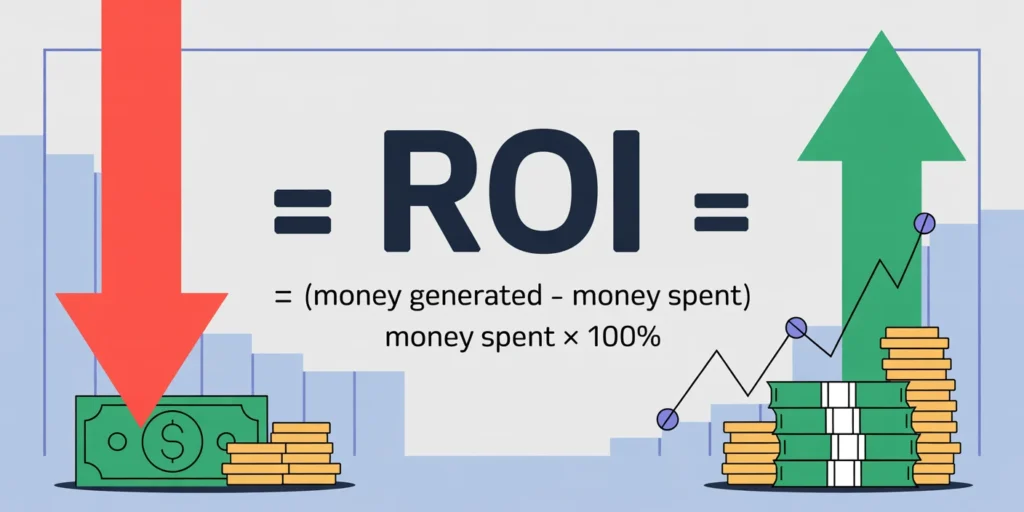
Marketing ROI measures the relationship between revenue generated and total marketing investment.
A high ROI signals efficiency and scalability.
A low ROI signals cost leakage, attribution gaps, or channel misalignment.
According to Gartner, organizations that fail to account for indirect marketing costs can overstate ROI by 20–30%, leading to poor strategic decisions
https://www.gartner.com/en/marketing/insights/marketing-analytics
The Formula
Marketing ROI (%) = Revenue Generated from Marketing -Total Marketing Cost/Total Marketing Cost ×100
This formula is simple, but only powerful when inputs are accurate.
What Counts as “Money Spent”?
A proper ROI calculation should include:
- Paid media spend
- Content creation and production costs
- SEO, AEO, and GEO investments
- Marketing tools and reporting software
- Agency retainers or consultants
- Internal marketing team costs (fully or proportionally allocated)
Incomplete cost tracking is one of the biggest reasons ROI reports lose credibility at board level.
What Counts as “Money Generated”?
Revenue attribution should be verifiable, not assumed.
This includes:
- Direct sales from marketing campaigns
- Marketing-influenced revenue tracked via CRM
- Assisted conversions across channels
Google emphasizes multi-touch attribution and revenue validation through analytics and CRM integration in its official measurement documentation
Example Calculation
- Marketing Spend: PKR 1,000,000
- Revenue Generated: PKR 2,500,000
ROI=(2,500,000-1,000,000)/1,000,000×100=150%
This means marketing generated 1.5x net return on investment.
Reporting Tip: Make ROI Executive-Usable
High-performing organizations do not stop at calculation. They operationalize ROI by:
- Reporting ROI alongside CAC and LTV
- Segmenting ROI by channel and campaign
- Connecting analytics with CRM and workflow systems
- Using dashboards instead of static spreadsheets
This is where AI automation, CRM integration, and structured reporting architectures outperform manual reporting.
What’s Next in the Series
This blog covered Formula 1: Money Spent vs. Money Generated.
Next blog:
Formula 2: Time Spent vs. Money Generated
Stay Tuned
Final Thoughts
2025 belongs to the brands that adapt faster and think smarter. Investing in these Digital Marketing Services isn’t an expense, it’s the foundation for future growth.
WebInfinites — your globally recognized Digital Marketing Agency for AI-driven corporate transformation.
